

The isekai genre dominates modern anime, but if you truly want to understand its heart, you need to go back to the source: the 1990s. This era wasn’t just about transporting a main character; it was about tearing them away from everything they knew and forcing them to confront complex, messy new realities.

Unlike today’s focus on cheat skills and game-like systems, the 90s isekai was about genre fusion, emotional maturity, and the heavy burden of being the “Chosen One.” For me, these five titles represent the very best of that time, blending flaws and brilliance into unforgettable adventures.
Retro Rebirth: Why 90s Isekai Anime Hits Different
1. The Vision of Escaflowne (1996)
This show is a spectacle. Director Kazuki Akane took shojo sensibilities—focusing on Hitomi’s psychic abilities and emotional journey—and smashed them into a world of high fantasy and giant mecha combat. It’s chaotic, but it works flawlessly.

While the character designs (particularly the elongated features) can be jarring for new viewers, and the Fox Kids edit was a crime against art, the original, sweeping narrative is flawless. Escaflowne set the benchmark for ambitious world-building and remains a cornerstone of classic anime storytelling. It’s mandatory viewing.
2. Magic Knight Rayearth (1994)
As a fan of shojo anime, I absolutely loved the vibrant colors and exciting magical girl transformations in the first season. This initial cheeriness, however, is a deliberate narrative trap.
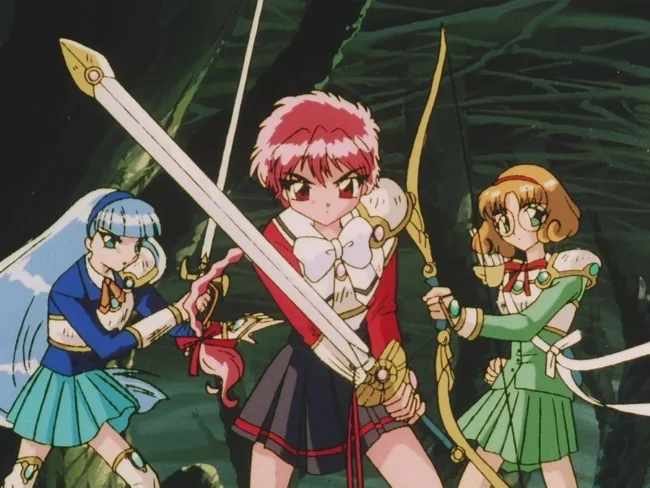
The supposed flaw—that the early episodes are just a fun monster-of-the-week setup—is what makes its payoff so devastating. CLAMP uses that initial escapism to deliver one of the most brilliant and emotionally crushing twists in 90s anime history. Rayearth isn’t just an adventure; it’s a poignant statement on the true price of “saving the world.”
3. Fushigi Yûgi: The Mysterious Play (1995–1996)
This is peak melodrama, and I mean that as a compliment. If you’re looking for high-stakes, passionate romance and intense political battles woven into Chinese mythology, look no further. It practically defined the shojo isekai subgenre.

The show leans so heavily into the romantic drama that the protagonist, Miaka, can feel frustratingly passive, relying too much on her “celestial warriors.” Despite that, the friendships, the rivalries, and the sheer stakes of her situation are handled with such emotional gravitas that you can’t help but get hooked. It’s an intoxicating, messy drama.
4. El-Hazard: The Magnificent World (1995 OVA)
Not every 90s isekai had to be a deep deconstruction. El-Hazard is the opposite: a joyous, high-energy, and often ridiculous adventure where a group of high schoolers are transported to a magical, war-torn world.

It’s the perfect showcase of the era’s imaginative OVA format. Yes, some of the jokes and harem tropes are a bit dated, but the designs are iconic, the humor is genuinely funny, and it just feels like a grand, effortless adventure. It’s a great example of the genre when it’s focused purely on fun.
5. Now and Then, Here and There (1999)
If the other four are the fantasy, this is the horror. Now and Then, Here and There transports its relentlessly optimistic protagonist, Shu, to a post-apocalyptic, war-ravaged world. It is bleak, visceral, and unflinching in its depiction of child soldiers and brutality.

It’s almost impossible to watch, yet it is utterly vital. This series uses the isekai setup to strip away all the escapist tropes, forcing viewers to confront the harsh reality of trauma and hope in the face of absolute despair. It is a masterpiece of mature, powerful storytelling and a testament to the fact that not all journeys to another world are magical.
What are your thoughts? Did I miss your favorite 90s anime entry in the Isekai pantheon? Let’s discuss the classics in the comments!
Last Updated on December 14, 2025 by Yu Alexius
Leave a Reply
You must be logged in to post a comment.